

Seller Guide Sep 16, 2026
Paraguay's used car market moves fast, and landlocked geography means most vehicles arrive by river barge from Buenos Aires or Montevideo before they ever reach a driveway in Asunción, Ciudad del Este, or Encarnación. That backstory matters, because it shapes everything from the paperwork you'll sign to the questions you should ask before handing over a single guaraní.
Whether you're browsing listings on CarAgencia's Paraguay marketplace or checking out a car parked on a side street in Capiatá, the process for buying a used vehicle here has its own rhythm: a notary-driven transfer system, a national verification requirement, and a tax structure that recently changed. This guide walks you through all of it, step by step, so you can buy with confidence instead of crossed fingers.
Why Paraguay's Used Car Market Works Differently
Because Paraguay has no coastline, nearly every imported vehicle travels the Paraguay-Paraná waterway before customs releases it, and only left-hand-drive vehicles are allowed in. That single rule already filters the market, but it also means paperwork history—import certificates, customs release, and nationalization documents—can matter even years after a car first arrives.
On top of that, Paraguay's Poder Judicial (not a transport ministry) runs the vehicle registry, called the Registro Único del Automotor. A 2025 reform, the Registro Unificado Nacional (RUN), is merging several registries into one system, with a single-window rollout expected through 2026 and full transition by 2029. Translation: today's paperwork requirements still apply, but expect the process to get faster and more digital over the next few years.
CarAgencia lists used cars for sale across Paraguay from both private sellers and dealers, covering cities like Asunción, Ciudad del Este, Capiatá, and Carapeguá. Listings include photos, descriptions, mileage, and pricing, and you'll need to register and log in to view full seller contact details and use the message center to make an offer or contact a dealer directly.
Browse the listings for even a few minutes and you'll notice how wide the mix of makes really is—Toyota, Hyundai, and Kia dominate for a reason, since they have the strongest dealer and parts networks in Asunción, but you'll also find GMC, Ford, Opel, and even Chinese brands like Baic and JMC alongside pickups, SUVs, and family sedans. That variety is good for buyers because it keeps prices competitive, but it also means parts availability and resale value can swing a lot by brand, so it's worth a quick search on how easy a specific model is to service locally before you fall in love with a listing photo.
Financing and Negotiating Tips
Most used car purchases in Paraguay are cash or bank-financed rather than seller-financed, so it's worth getting pre-approved financing lined up before you start seriously negotiating. Sellers respond faster to buyers who can move quickly to the escribanía. If a dealer offers in-house financing, ask for the total cost, including interest, in writing—not just the monthly payment—since that's the number that actually tells you what the car costs.
On price, remember that the certificates and escribano fees add a real, calculable amount on top of the sale price, so factor that into your opening offer rather than negotiating down to your absolute ceiling and getting surprised by closing costs. It's also common practice to split some costs between buyer and seller—for example, the seller covering the no-robo and no-adeudar certificates since those prove the car is clean, while the buyer covers the verification and notary fees since those are part of taking ownership. None of this is legally fixed, so agree on who pays what before you show up to sign anything.
Paperwork and Documents You'll Need
Nothing derails a car purchase in Paraguay faster than showing up at the escribanía missing one document. Because the transfer must happen through a notarized public deed (escritura pública) for cars—unlike motorcycles, which can sometimes use a simpler private contract—every document below needs to be original, current, and in the seller's exact legal name.
Document | Why You Need It |
Cédula Verde / Título de Propiedad | Proves the seller legally owns the vehicle; must match the seller's name exactly. |
Cédula de Identidad (CI) or RUC | Identifies buyer and seller for the notarial deed and the RUN registry. |
Certificado de Verificación Física | Confirms chassis, engine, and VIN numbers match the paperwork; required at a planta verificadora. |
Certificado de No Robo | Police certificate confirming the car isn't reported stolen. Valid roughly 30 days. |
Certificado de No Adeudar (municipal) | Shows the vehicle has no unpaid municipal patente (road tax) debts. |
Escritura Pública de Transferencia | The notarized public deed an escribano drafts to legally transfer ownership—mandatory for cars. |
Comprobante de Pago de Patente | Receipt showing the annual vehicle tax is current for the registration year. |
A Quick Note on Taxes
Under Paraguay's Ley 6380/19, how the sale gets invoiced depends on the vehicle's value. For vehicles sold under roughly Gs. 20,000,000, the buyer typically issues a self-invoice (autofactura) with no VAT or income tax due. Above that threshold, the seller may need to register for capital gains tax (IRP) within 30 days of the sale. If the seller is a business selling from company assets, VAT and corporate tax rules apply instead.
This is genuinely one of the more confusing parts of buying a car here, so don't hesitate to ask your escribano to walk through which category your purchase falls into.

Step-by-Step: How to Buy a Used Car in Paraguay
1. Search and Shortlist on CarAgencia
Filter by make, model, city, and price, and read each listing's description carefully. Sellers are encouraged to include detailed condition notes and 5–7 photos, so a thin listing is worth a second look before you commit time to it.
2. Register and Message the Seller
You'll need to create a CarAgencia account and log in to view full seller information. From there, use "Make an Offer" to propose a price or "Contact Dealer" to send a direct message.
3. Inspect the Car in Person
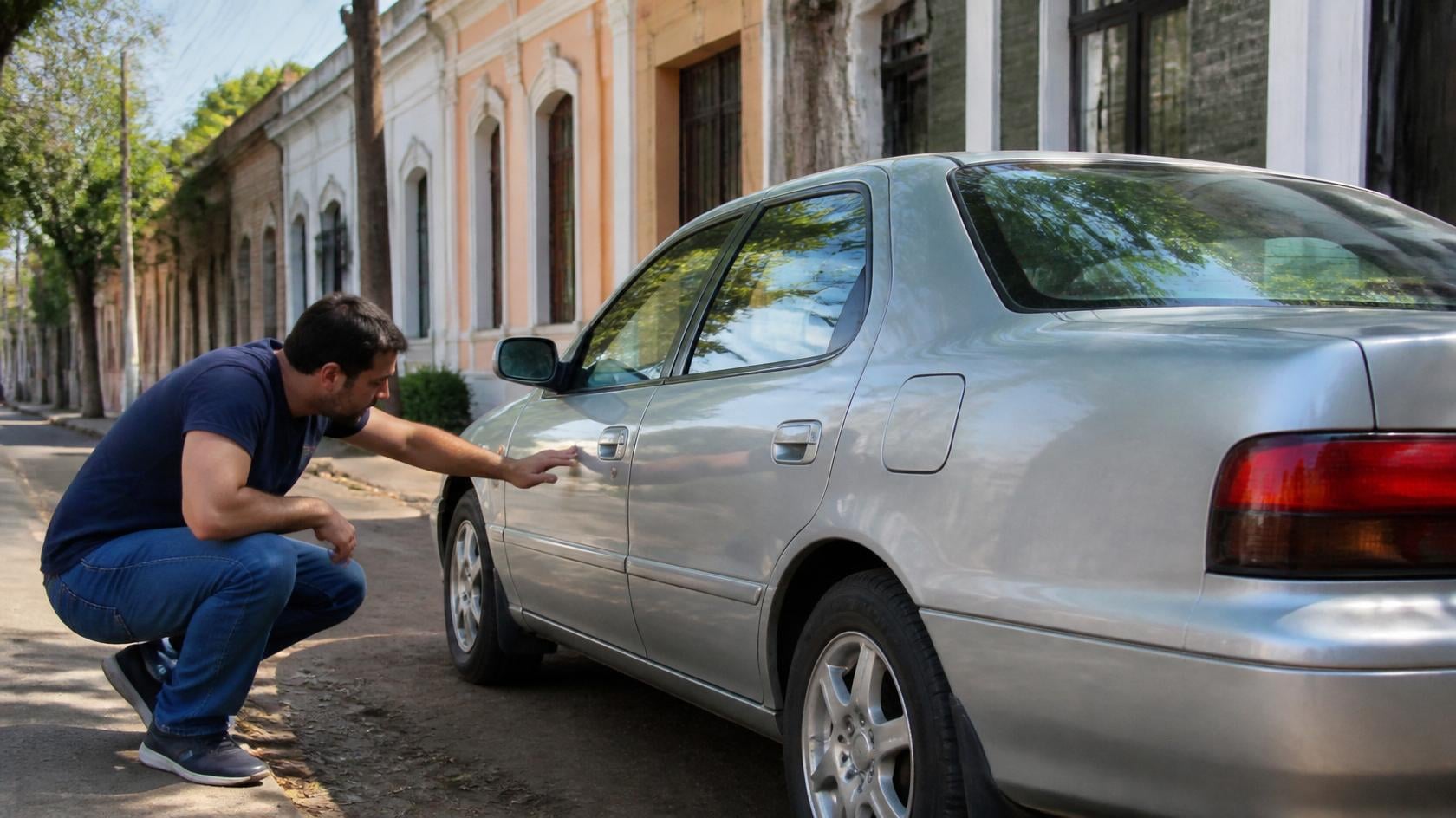
Check the odometer against wear patterns on the pedals, seat, and steering wheel. Mileage rollback is a known issue in Paraguay's used car market. Independent inspection services exist locally if you want a professional opinion before committing.
4. Confirm the Paperwork Matches the Car
Compare the chassis and engine numbers stamped on the vehicle against the cédula verde and título de propiedad. Any mismatch is a reason to walk away, not negotiate.
5. Get the Certificado de Verificación Física
This happens at one of the plantas verificadoras located in cities including Asunción, Ciudad del Este, Encarnación, Coronel Oviedo, and Villarrica. A technician confirms the car's identifying numbers are authentic and untampered.
6. Collect the No-Robo and No-Adeudar Certificates
These confirm the car isn't reported stolen and has no outstanding municipal patente debt. Both are usually the seller's responsibility but are worth double-checking before the deed signing.
7. Sign the Escritura Pública with an Escribano
This licensed notary drafts and formalizes the transfer deed, calculates the applicable fees and IVA, and submits the paperwork to the Registro del Automotor.
8. Pay the Registry and Judicial Fees
These cover the RUN filing and vary based on the vehicle's declared or fiscal value.
9. Update the Patente Vehicular
As the new registered owner, you'll be responsible for the annual road tax from that point on, calculated using a depreciation-based formula introduced under Ley 7447/2025.
What a Typical Transfer Costs
Exact fees shift with the vehicle's value and the escribanía you choose, but here's a realistic breakdown of what tends to show up on a used car transfer in Paraguay.
Cost Item | Typical Range (Gs.) | Paid By |
Escribano (notary) fees + 10% IVA | Varies by vehicle value | Usually buyer |
Certificado de Verificación Física | Set by planta verificadora | Buyer or seller |
Certificado de No Robo | Gs. 50,000–100,000 | Seller (usually) |
Certificado de No Adeudar | Gs. 30,000–80,000 | Seller (usually) |
Judicial / Registry Tax (RUN) | Percentage of fiscal or sale value | Buyer |
Annual Patente Vehicular | Depreciatin-based formula | New owner |

Paraguay's used car market has a reputation—including among local buyers—for a few recurring headaches: rolled-back odometers, mismatched chassis numbers, and cars still carrying unpaid patente debt from a previous owner. None of these are dealbreakers if you know what to check.
Never Skip the Verification Plant
It's the single strongest legal safeguard against buying a stolen or altered vehicle, and it's required by law before any transfer can register.
Match Names Carefully
The seller's name on the cédula verde must match their CI or RUC exactly. A mismatch usually means an unresolved prior transfer or a middleman trying to skip a step.
Ask for the Import History
If a car came in under the temporary admission regime (typically a 90-day window for new residents), confirm it was properly nationalized. Driving on an expired temporary permit can lead to fines or impoundment, and that risk transfers to you as the new owner.
Use CarAgencia's Message Center
Keeping offers and questions inside the platform creates a written record if a dispute comes up later.
Consider a Professional Inspection
Independent, in-person mechanical inspections are available locally and can catch hidden engine, chassis, or flood damage before you're financially committed.

Budget Time, Not Just Money
Between scheduling a verification appointment, gathering certificates, and booking the escribano, a transfer commonly takes one to a few weeks. Don't let a seller rush you into skipping a step to "save time."
Buying from Abroad?
If you can't be physically present for the signing—say, you live outside Asunción or you're buying from abroad—a poder notarial (notarial power of attorney) lets a trusted representative sign the escritura pública on your behalf. Just make sure the power of attorney is drafted specifically for a vehicle transfer, since a general power of attorney may not cover it, and confirm with your escribano that it will be accepted before you rely on it.
Ready to Start Browsing?
Buying a used car in Paraguay rewards buyers who do their homework. Once you understand the documents, the escribanía process, and the verification requirement, the rest is mostly patience and a good eye during inspection. Browse current listings across Paraguay on CarAgencia, message sellers directly through the platform, and use this guide as your checklist from first offer to final signature.
One last piece of advice: keep copies of everything. Once the escritura pública is signed and the Registro del Automotor processes your transfer, hold onto the certificates, receipts, and correspondence with the seller for at least a few years. If a question ever comes up about the vehicle's history—a disputed patente payment, a warranty claim, or simply reselling it down the line—having a complete paper trail turns a potential headache into a five-minute conversation.
Frequently Asked Questions
Can foreigners buy a used car in Paraguay without residency?
Yes. Foreigners can purchase a used vehicle in Paraguay, though the notarized transfer still requires valid identification, and some escribanías may ask for a passport plus proof of a local address or a Paraguayan identification number for the registry filing. If you're not a resident, ask your escribano ahead of time exactly which ID documents they'll accept.
Do I need to visit a planta verificadora even if I'm not importing the car?
Yes. The Certificado de Verificación Física is required for domestic transfers too, not just imports. It confirms the chassis, engine, and VIN numbers on the car match its paperwork, and it's a mandatory step before the Registro del Automotor will process any ownership change.
How is the annual patente vehicular calculated in Paraguay?
Since Ley 7447/2025, the patente uses a uniform formula nationwide based on the vehicle's value and a depreciation rate of about 5% per year of age, capped at 50% after ten years. A vehicle's declared value, minus its depreciation, becomes the base for the annual tax calculation.
What's the RUN reform, and does it change how I buy a car today?
The Registro Unificado Nacional (RUN) is a multi-year project merging Paraguay's vehicle registry with other public registries into one unified system. For 2026, expect a single-window intake and tracking number for transactions, but the actual documents and steps required for a transfer haven't changed yet. The digitization is happening gradually through 2029.
Is it cheaper to buy from a private seller or a dealer in Paraguay?
Private sellers on platforms like CarAgencia often list lower prices since there's no dealership markup, but dealers may offer more consistent paperwork and sometimes financing connections. Either way, the same verification, notarization, and registry steps apply. The seller type doesn't change your legal obligations as the buyer, so don't assume a dealer has already handled the certificates for you. Always confirm what's included before you agree on a final price.